Loss of a friend
a sculpture by Bruce Krebs
versions

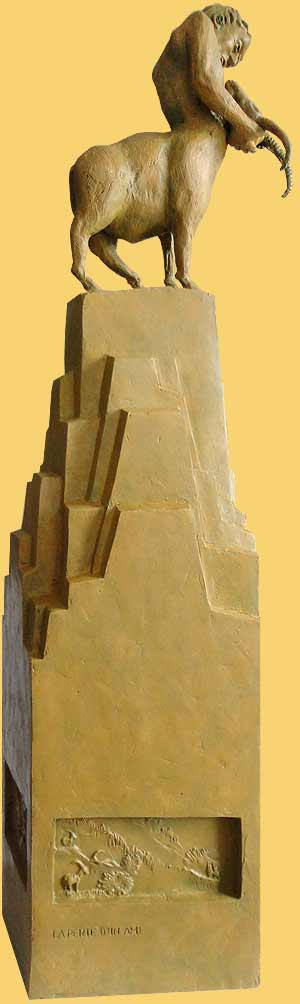
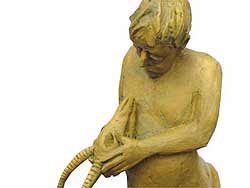
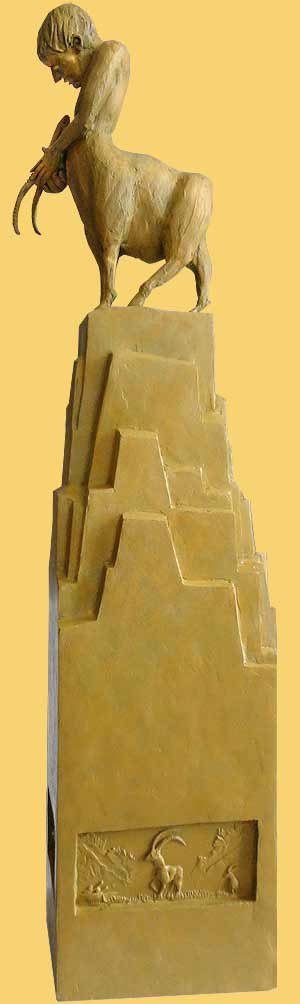
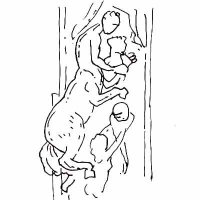
A sad man holding a skull in his hands. This is not Hamlet. More precisely, it is not a man. It's a centaur! More precisely, it is not a human skull instead, it is a skull of an ibex.
Moreover, this character does not look like a centaur from Greek mythology. He does not have a horse body but a body of ibex ...

It took me 3 years
before I decided to truncate
the mountain and refocus
the sculpture on the friend....
(Here below is the previous version with the mountain as it was and its four bas-reliefs...)
|
 the contemporary art gallery ?
There are many sculptures of centaurs. It is rare that there centaurs take the best part: they kidnap women, they are attacked violently by Theseus, Heracles (Hercules) ... They symbolize the enjoyment, but never sculpted as such. Over the centuries the topics have evolved, episodes of mythology fade gradually. Soon the image of centaur is reduced to that of a logo.
Here are some examples:
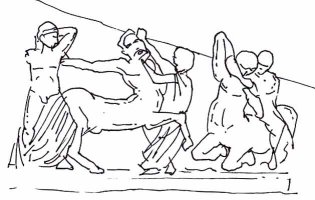
On the pediment of a temple to Zeus high four centaurs are represented, drunk, fighting with the guests at a wedding party Lapith. They receive more hits than they give! This relief is partly restored in the Archaeological Museum of Olympia.
(The Archaeological Museum at Olympia, Greece)
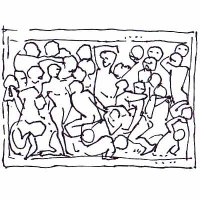
Closer to home, in the fifteenth century, Michelangelo young carved a small bas-relief "The Battle of the Centaurs and Lapith" which, oddly enough, we do not see evidence of a hoof or the tail of a horse ... (Maybe the fallen man is a centaur. It is difficult to say because this sculpture is very impressionistic ...) You can find this bas-relief in the birthplace of Michelangelo in Florence.
(Casa Buonarroti, Florence, Ghibellina Street)
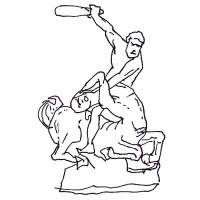
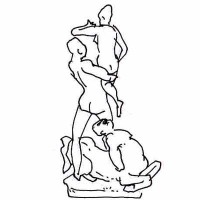
Also in Florence, in the Loggia dei Lanzi, you can discover "Hercules fighting with centaur Nessus." Faced with Hercules, the centaur seem small. Giambologna represented the centaur "kneeling", arched back. Hercules will hit ...
(The Loggia dei Lanzi in Piazza della Signoria in Florence)
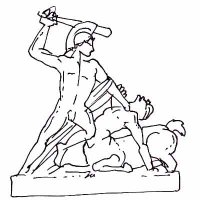
In such beating, in the early nineteenth century Canova, sculptor appointed the first empire, carves a hieratic Theseus striking the unfortunate Bienor, Centaur his state, too arched and four knees to the ground.
(Kunst historisches Museum de Vienne)
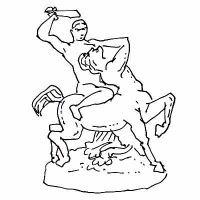
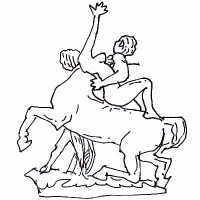
Antoine-Louis Barye takes this theme at the end of XIX, and very close to that of Giambologna in Florence presentation. But not with the same title: "Theseus and the Centaur Bienor" ... So Hercules straddled the centaur here Theseus bareback on his back!
(Art and History Museum of Cholet, Louvre Museum and square Barye, at the end of the ST Louis Island in Paris)
Alfred de Vries designed a sculpture where the unfortunate centaur Nessus is tied to the feet of Hercules. Deianira is in the arms of her lover. If the centaur seems small compared to the proportions of Hercules, the young woman, meanwhile, seems to have a middle Herculean ...
(Musee du Louvre)
In the Tuileries gardens in Paris, Laurent Marqueste end XIX, XX th beginning, created "The centaur Nessus removing Deianira." For once, though that reaches by an arrow in the shoulder, the centaur is represented in full strength. Deianira can not escape.
(Tuileries Gardens)
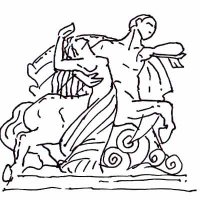
In 1928, Raymond Delamarre, very Art Deco, adopts new proportions for the centaur. He's big, strong and dominant. Its Nessus, despite planted in the heart arrow, looks very powerful and frail Dejanira ... Nessus, the left hand seems to remove the arrow that pierced.
In the 1880s and later, no longer encumbered by Rodin mythology. It creates a centaur with the technique of layering. (This technique consists of two independent fragments together to create a new work. Here, a woman and a horse.)
He made ??no effort to "anatomical sense." The hips of the woman does not correspond to the horse's shoulders as his predecessors wanted ... Surprising: The bust seems to go forward while the rest of the body seems back!
(Musee Rodin, in Paris)
Rodin sculpted as a centaur on the left side of the "gates of hell". Unlike his colleagues at the time, there are few horses in the work of Rodin (I think at the monument to Claude Lorrain, whose base has two horses probably carved by his friend Jules Desbois). The centaur is more visible on the plaster of the Musée d'Orsay on the bronze when it is dimmed Rodin Museum ...
(Musee d'Orsay, Musee Rodin)
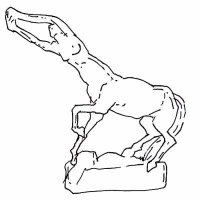
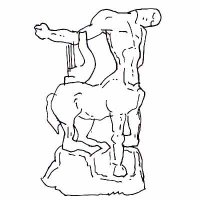
With "the dying centaur" Antoine Bourdelle there sign one of its most surprising sculptures. The idea of this lyre is amazing! While in mythology, the lyre was among the instruments of centaurs. The centaur raises his arm, his fist still closed. Three legs are already lying, the fourth is still right. It is illusion, because the ground seems to sink under its own weight ...
(Bourdelle Museum in Paris)
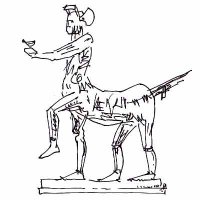
The Cesar's Centaur dates from the 1980s. This is a very beautiful work (especially at sunset). Cesar recaptured the myth for the update. Today the power is no longer the preserve of horses. The mechanics replaced them. Cesar therefore a mechanical man! (A man-horsepower ...)
(Intersection of la croix-rouge in Paris)
the contemporary art gallery ?
|
Bruce Krebs, sculptor 9 ter rue Amelot, 17 000 La Rochelle, Charente Maritime, Poitou-Charentes, France, Europe. To send me an E-mail:atelier.bruce.krebs@wanadoo.fr |