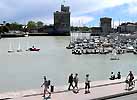
Here a photograph which never existed! In fact, it is an assembly of ten photographs chosen among the photographs of the first campaign air photographs of 1922. This air countryside is preserved at the La Rochelle Municipal Archives.
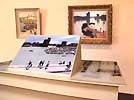
There are details very interesting to observe:return towards research in connection with the Albert Marquet'painting.The mud invaded the basin of the "old port". The landing stage for the island of Re is almost opposite the current street of the port. (It moved with Port de La Palisse at the beginning of the Fifty). This landing stage functioned only with high tide, at any hour of the day or the night... Along the Duperré quay, one of the "ferry-boat" of the island of Re (in white) is moored. This ferry-boat still functioned with paddle wheels which one distinguishes from each with dimensions of his hull.
Their dimensioned, the trawlers left the prints of their stems in the mud. The shipyards are side by side in front of the ramparts, in the site of the current place saint Jean d'Acre. Close to the flow of hunting of the Maubec channel, four boats wait on the grill of careenage.
There is also a very large ship in the port with flood. One can wonder how it could pass the lock. The shade of its masts is as large as that of the Tower Saint Nicolas!
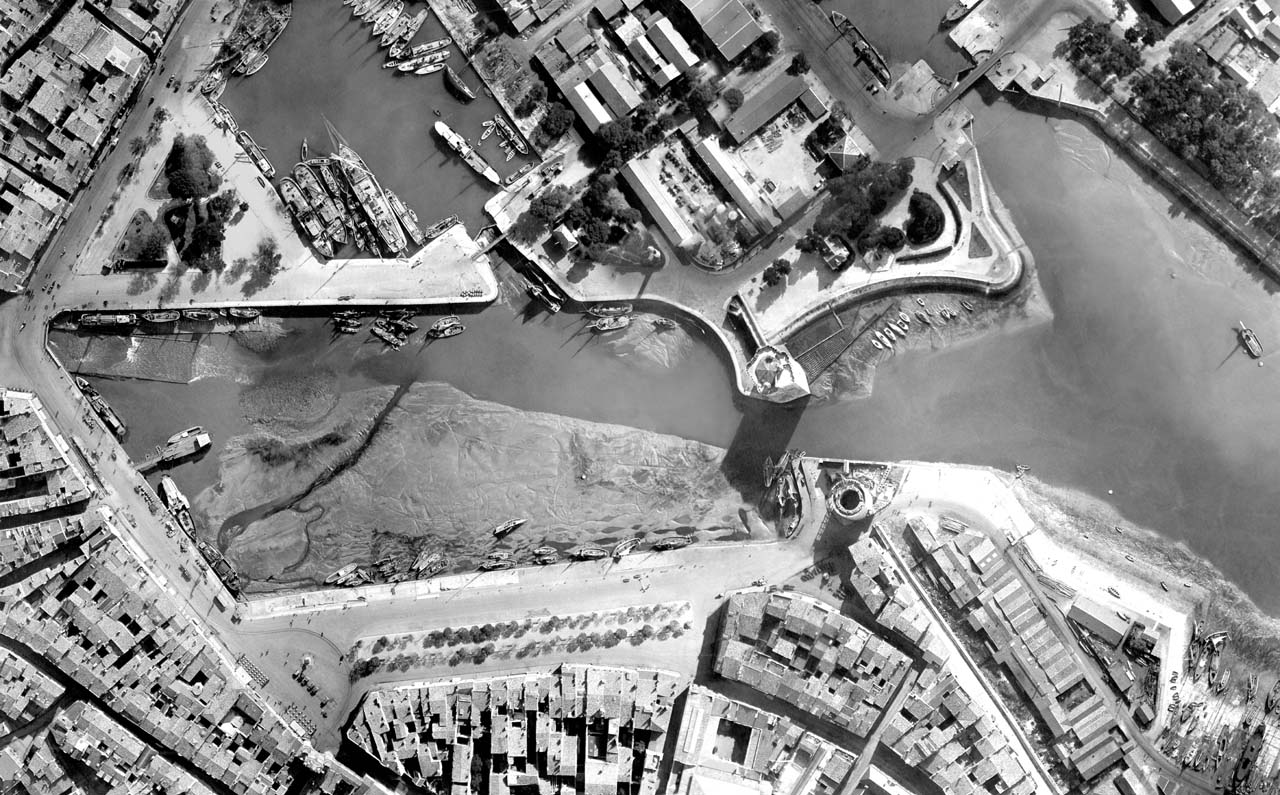
The Tower of the Chains does not have a roof! It is in work, one distinguishes the shade from his scaffolding. Following a long lawsuit, work of the Tower of the Chain lasted ten years... (For this reason on the many old photographs the tower is always in the course of restoration). The tableau of Albert Marquet, that one of La Rochelle Fine Art Museum, represent, also, the unfinished tower of the Chains. Court of the auction (the place where were sold the fishing years) is not covered with a canopy like, nowadays, the "Coursive"...
In front of the tower St Nicolas, in the medium of a hexagonal platform, draws up a post from which one distinguishes a very great shade, it is the semaphore. It is located in the axis of the roads. Thanks to a code that all the sailors knew, this semaphore, visible by far, indicated, hour per hour, the level of the water of the basin. (we could distinguish also this semaphore on the Albert Marquet'painting.) Behind this semaphore the district called "le Gabut" made up of workshops and shipyards. At this time, the bridge which leads now to media library, was not tilting, but swivelling like the small footbridge of the port with flood.
By noting the low thickness of the trees of the Course of the Ladies, the photographs were taken in winter. One distinguishes very well the rails from the tram which pass under the Large Clock ("la Grosse Horloge"). The coffee terraces are ready to receive their customers. But it is a little early: 9 hours if one judges the orientation of the sun of it. The hackney carriages also are aligned (almost at the same place as the taxis nowadays).
That to still say, this photography is rich information. Small pleasure boats ride at anchor in front of the tower St Nicolas. It is a rather dangerous anchorage. But at that time, the port was a place of work, not leisure! The "yachts" did not have right of city there... The things changed well as one can see it our day.